Who Killed Santa Claus?

The intersection of story and memory and perception is a funny thing.  It isn’t just the details of the narrative but how we perceived it at the time – in other words it’s not just what happened but how did our five year old self understand what was happening  – that’s where the story lives.
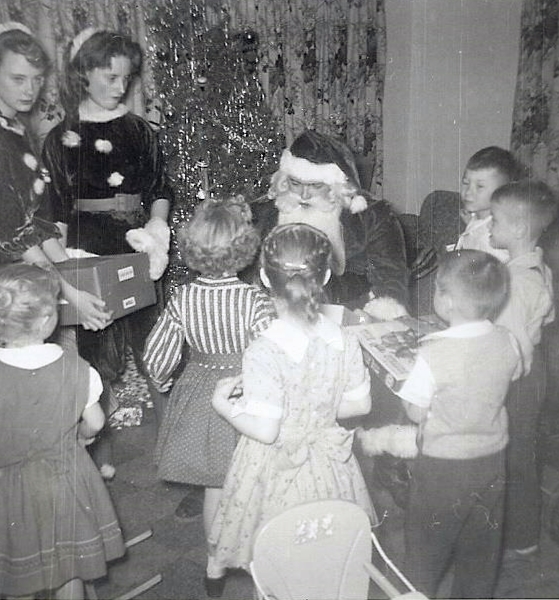
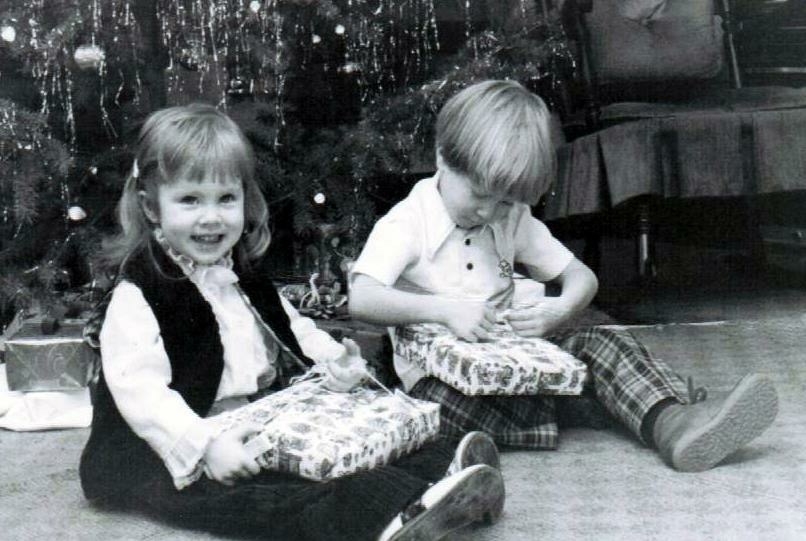
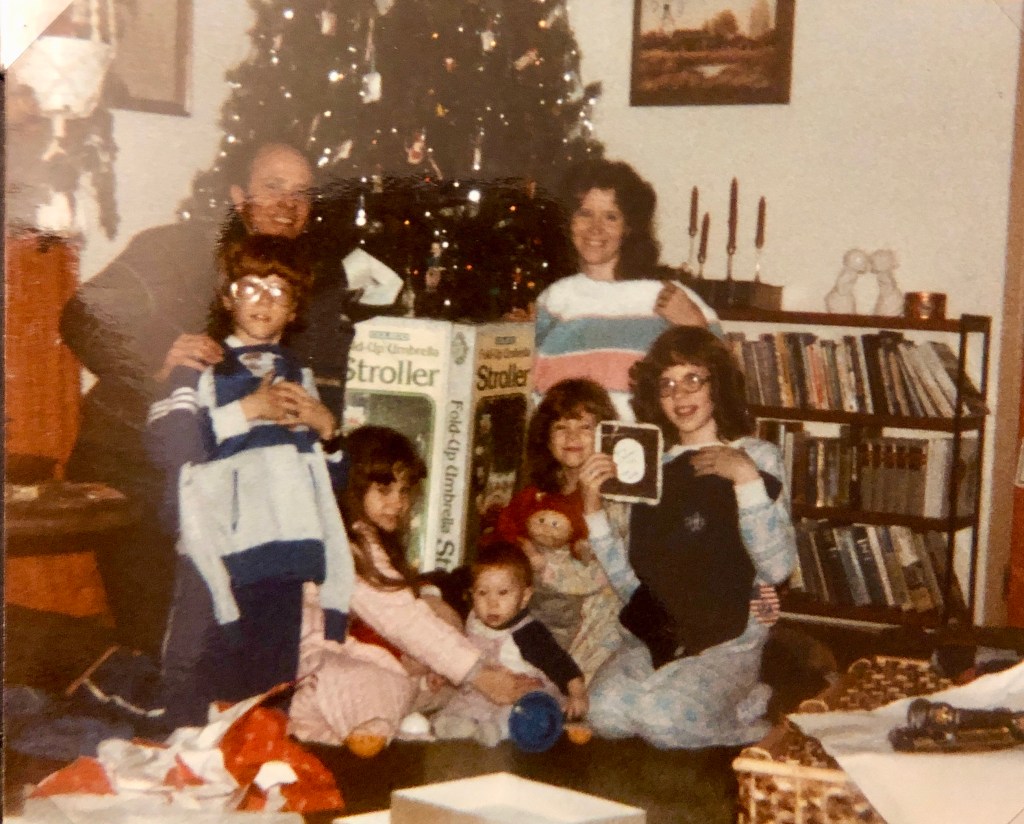
Santa  visited our house every Christmas Eve with his elves and pack of presents. That’s me in the pony tail with my back to the camera.

Our kids will tell you that we didn’t “do Santa Claus” for religious reasons. In fact, the truth is nothing so noble. Paul and I were both raised on the fat man in the red suit who brought toys to good boys and girls. As parents, we didn’t do Santa Claus because we couldn’t afford many presents and I wanted the credit for giving them the cool gift. There, I’ve said it out loud and now you know what a truly selfish and awful person I really am. I wasn’t going to let Santa swoop in at the last minute to give them that thing I had scrimped and saved and stood in the blocks-long line to get the day it went on sale. The jolly old man had made not one sacrifice to obtain this year’s must-have toy, and he certainly was not going to get to play the hero in my stead. 

Our kids each got three gifts from us – I think because that’s the way it was in Paul’s family. We tried to get them one thing they really wanted, and then the other two were something small:  a book, a craft, something to go with their toy (an outfit for the new doll, etc.) or maybe new pajamas or slippers (One year I sewed nightgowns and robes for all the girls.  Don’t ask – I have no idea why I thought that was a good idea. This is the same year that Sean found the scraps of fabric on my bedroom floor and was convinced I was making them a Punch & Judy puppet show. Who knows where that came from ??!!)   These gifts were purchased, wrapped and hidden away until Christmas morning. 

The little gifts they made or bought for one another and for us were carefully selected and fussed over (was this really what she would like or maybe it was that or maybe something else all together??), then wrapped with care and lots of tape and placed under the tree to be poked and prodded and arranged and rearranged all through the weeks leading up to Christmas (and sometimes re-wrapped). 

Until Christmas morning.

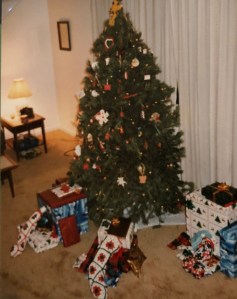
After they are asleep – or all in bed with a promise of physical harm should they exit their bedroom before morning – Paul and I bring out our oh-so-carefully-chosen and hopefully something-they-will-love offerings.  Gifts are always arranged in piles according to the giver so that the emphasis will be on “what you are giving” instead of “what you are getting”. Everything you are giving to someone else is placed in a stack at your spot with your stocking – hand crocheted  by Grandma Fletch – and then we wait for the morning. 
fullsizeoutput_552b

No one is allowed to leave their bedroom until you hear the music – Manheim Steamroller’s Deck the Halls – blasting loudly enough to wake the dead.  Of course, they are all awake, or maybe had never gone to sleep, but they dutifully wait for their cue. The music calls to them and here they come, scrambling down the stairs or up the stairs depending on where their bedroom is, running to find their stocking and their pile of gifts to give and eyeing the stack in front of Mom & Dad.  Those will be the last ones distributed.  

67d390aa3636d7dbee1952c5f1a1593c

We start with the youngest who gets to choose in which order he or she wishes to bestow what everyone already knows will be a Life Saver Storybook. I no longer remember how this tradition began, but early on it was the mandated gift that the youngest among them gives to the older siblings. With much fan-fare, everyone oooohs and awwwwwws over it as though it is the biggest surprise of the season and one which they cannot possibly live without. 

Gifts are opened one at a time since this allows for time to admire and exclaim over each one and we all compliment the giver on his or her good taste. One by one, we ceremoniously present our gifts  to one another and everyone watches as each one is opened. This takes awhile and has the added benefit of alleviating the frenzied ripping of paper that inevitably leads to mass confusion and chaos and cuts down on the number of times we will need to dig through the trash looking for a lost doll shoe, Lego piece or other sundry tiny items. Plus it stretches out the festivities and makes more of a party, which in our family is always a good thing.  

And that was Christmas morning.   

I don’t know if our kids missed not “doing Santa”.  The truth is I never asked them.  I realized pretty early on though that we needed to have “the talk” if we didn’t  want our friends and neighbors to hate us and our kids. “Some people like to pretend that Santa Clause is real,” we explained, “and that he is the one who brings their children presents and so you can help them by not saying anything that would make them out to be a liar.” I mean, we didn’t say it exactly like that, but we had to coach them up a little to keep the peace.

And then there was the year that one of our Sunday School teachers at church killed Santa Claus. He wanted to teach a lesson about the real Saint Nicholas and how the “Santa Claus” of today grew out of the myths and legends (danger Will Robinson!!) around this real man who lived in the third century.  And while I’m sure he meant well (you can probably see already how fraught with peril this plan was), he somehow failed to see the landmine he was about to trip over. So somewhere in his lesson about this kind and generous patron saint of children, he comes to the place in the story where Saint Nichols  dies. Now to a small child, who only vaguely understands anything you have said up to this point but who thinks you are telling him that Santa Clause and Saint Nicholas are one and the same, this is, of course, alarming.  “Santa Claus died?” asks a small voice in the front row.

At this point, any thinking person would have abandoned his ill-conceived lesson and just gone straight to the craft tables, but he soldiers on. Another little voice, with a hint of a quiver, asks “How did he die?” And then the mother of all landmines: “He was martyred,” says the teacher.  KABOOM!!  While most sources say Saint Nicholas was persecuted for this faith, I can’t find anybody who says he was martyred, but given this was before the internet, maybe this teacher didn’t have access to good research or maybe he just thought it made for a better story.

At any rate, that’s what the teacher said. Now there is a full-blown panic rising from the masses as one child jumps to his feet and yells  SANTA CLAUS WAS MURDERED??!!  (martyred or murdered – what’s the difference, really?) And it was at this moment that all hell broke loose and became known in the history of our church as “The Day Cedarbrook Killed Santa Claus.” Our son, who was about 10 and one of the older kids in the class, was standing in the back of the room with a friend who says to him, “Do you still believe in Santa Claus?”  Nope.  “Me neither. But I sure feel sorry for these kids.”

We fielded a deluge of calls from irate parents that week, letting us know how traumatized their children were as a result of the Sunday School lesson and that when it came time to explain the “Santa situation”, they had expected to be the ones to do it and they certainly would have handled it much differently, thank you very much.  

And though I didn’t say it, because I thought it might be too soon, I thought about telling them, “Yes, but just think, now you’ll get to take credit for all that stuff under the tree.”  

murdoch
No one was taking credit for this one but me!

Daily Bread

“There are things you do because they feel right & they may make no sense & they may make no money & it may be the real reason we are here: to love each other & to eat each other’s cooking & say it was good.”

It is one of my favorite Story People stories. We have it framed and hanging on our “family wall” in our living room. I think it belongs there because food is a part of every family’s story whether we recognize it or not – or at least it is a part of our story.

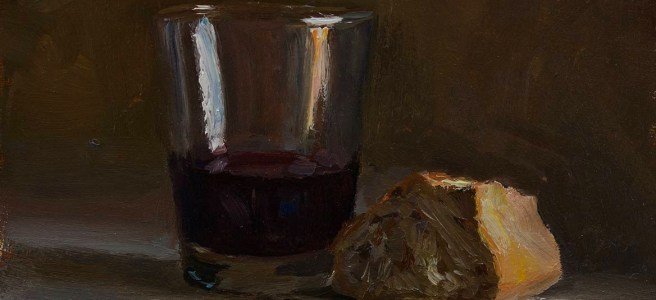
It’s the story behind Crescent Rolls and Chicken & Noodles. Canned Jellied Cranberry Sauce and Donuts. Chili and Cinnamon Rolls. Tuna Noodle Casserole and Vegetable Soup. Coconut Pie and Apple Pie made from orchard apples. Bread and Wine.

My mother was the best cook of anyone I have ever known. I, on the other hand, got married barely knowing how to boil water. Paul always thought it was a bait-and-switch:  he came to my house, ate my mother’s cooking and just assumed it was a genetic thing and this is what he could expect when we were eating out of our own kitchen. It was a hard adjustment for him – we ate out a lot and went to my mom’s house once a week for dinner. But slowly I began to take an interest and figured some things out.

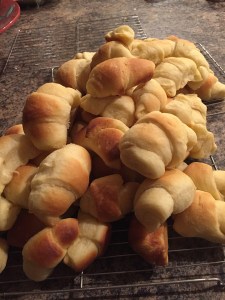
Crescent Rolls: On our first son’s first birthday, I wanted to do something special. So I opened my Better Homes and Gardens Cookbook  I had received from my niece as a wedding gift with the inscription that read:  “Dear Paul, good luck.  You’re going to need it.”  I found a recipe for Crescent Rolls. Perfect! How hard could this be. Turns out . . .  pretty hard.  It was a time-consuming recipe which took most of the day, but so worth it! Over the years I tweaked the recipe to my liking and they became a “must have” for holiday meals. The story is still told about the year that “one of us” set his alarm and rose at 5:00 a.m. on the day after Thanksgiving to eat all the leftover rolls before anyone else could get to them – in a big family one must learn to out-wit, out-play and out-last the competition. We’ve had some glitches along the way. There was the year I forgot to set the timer and burned the bottoms to a blackened charcoal on the Wednesday before Thanksgiving. So we cut the bottoms off, slathered them with butter and called it dinner that evening. Then I set to work on the next batch which took me late into the night. There were years the yeast didn’t rise because the milk was too hot or not hot enough and I had to start over. But if you come to our house on Thanksgiving or Christmas, you will get Crescent Rolls.

crescent rolls

Chicken-and-Noodles:  In those early years as I was expanding my repertoire I asked Paul, “What did your mother cook that you really loved.”  He fired back, “Home-made Chicken and Noodles!!”  So I made the long distance call to his mother to get the recipe and set out to wow him. I followed exactly the recipe my mother-in-law had copied from a newspaper column decades before. When it said, “Roll the dough very thin and cut into strips,” I labored with my rolling pin, stretching and rolling and pulling and rolling until the dough was indeed paper-thin. It was a labor of love, if a frustrating exercise, but I was determined to replicate his mother’s dish. I sat down to dinner ready to bask in his awe and admiration and gratitude.  “What is it?” He stared into his bowl of paper-thin, perfectly cut noodles swimming in broth. Are you kidding me?  It’s Chicken and Noodles!  “No”  NO??!!   “Well, it’s not my mother’s chicken and noodles.” So I got up from the table to make another call. “I followed the recipe exactly and he says I didn’t get it right?  What happened.?”  I could hear the commotion in the background as she was rushing to get dinner on the table for the six kids still at home. “Read the recipe back to me,” she said over the din of two kids arguing over whose turn it was to the set the table. When I came to the part about rolling the dough paper thin, she interrupted me. “Oh good grief, Sherry!  I never had time to mess with that nonsense. Just give it a few swipes of the rolling pin and call it good!” Okay then.  And so now my own family thinks if the the noodles are not thick and almost chewy with a thick broth and huge chunks of chicken – then it’s not really Chicken and Noodles. Following a recipe can be so over-rated.

Jellied Cranberry Sauce:  As I honed my skills in the kitchen I developed an attitude that “made- from-scratch-is-always-better” and so cranberry sauce should be made with fresh cranberries and a zested orange. Truth be told, nobody ever ate it but me, but that’s how I did it. Then our son-in-law joined the family and when we sat down to Thanksgiving dinner his first year he asked for the cranberry sauce.  It was passed around the table to him. Nope. He was looking for the jellied cranberry sauce that comes out of a can. Now, every year, he gets a whole can of it to himself, and I eat the other.  And everybody goes home happy.

dd 2

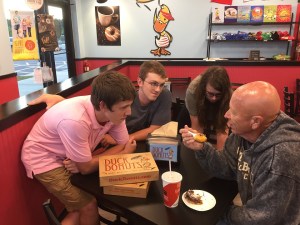
Donuts:  We were at the beach and Paul and I were headed out to the grocery store.  I called out “Does anybody need or want anything from the store?”  The four year old grandson never looked up from his Lego’s. “How ‘bout donuts!?” he yelled. And now, twelve years and eight grand-kids later, you haven’t been to Nana & Colonel’s until you’ve gone for donuts. The littles always love to hear how, when we were first married, Colonel was the guy who made the donuts at Dunkin’ Donuts and could eat all the donuts he wanted every night. I know, it’s not hard to impress them when they’re young.

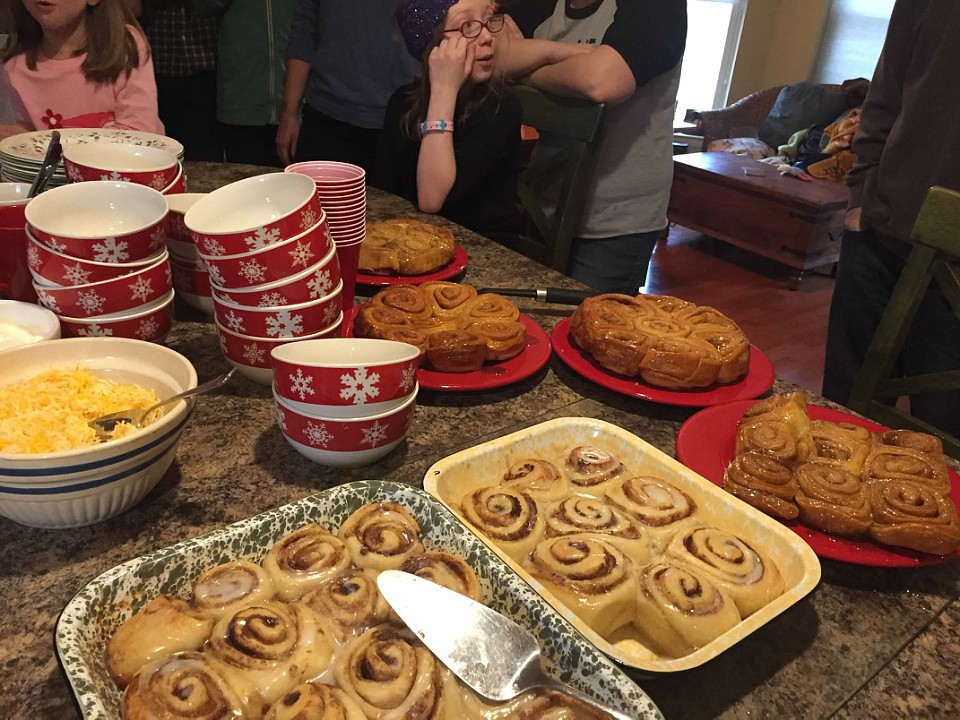
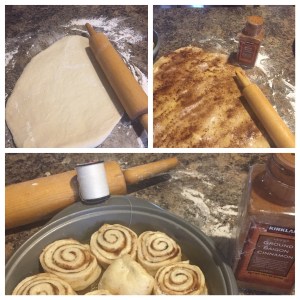
Chili and Cinnamon Rolls:  In both our families, the traditional Christmas Eve dinner was soup. At the Abbotts it was Chili.  At the Fletchers it was Chile and Potato Soup and Oyster Stew. At the Fletcher’s it was Cinnamon Rolls and Potica (a wonderful Slavic Sweet Bread introduced to our food culture by my brother-in-law’s family).  At the Abbotts it was Cinnamon Rolls and since I never mastered the art of Potica making, we stick to the Cinnamon Rolls. There was the year that I got distracted in the making and instead of dividing the dough into halves to make out the rolls I divided it into thirds and ended up making more, but much smaller rolls. I didn’t realize my mistake until one of the kids who was home for the holidays said, “It’s funny, when I was a kid these rolls seemed to be so big they filled your whole plate and now it seems like I could eat three of them,”  Yup, pretty much. The year our son was in Iraq we sent a can of Hormel Chili and a box of Honey Buns in his Christmas package.  In some way or another, I think most of the kids have carried on the tradition and live out the story.

234b6f7b-22c5-438e-862c-0de8c07e81d9_1.c0abf0f4a9caf497046c36c2be377847

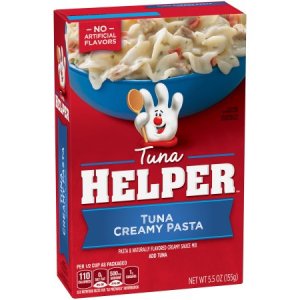
Tuna Noodle Casserole and Vegetable Soup:  Like most families, in ours you got to pick the dinner menu on your birthday. When our youngest was little, his favorite meal was Tuna Noodle Casserole. Nobody else really liked it so we rarely had it, but on his birthday he got to choose. One year he was spending his birthday with some family friends because Paul and I had to be out of town. Peggy asked him what he wanted for dinner. Tuna Noodle Casserole – of course!  “Does your mom have a special recipe she uses?” Having five kids of her own she understood the risk of making something that was not like Mom’s.  “Yes, she does. It’s on the back of the box.”  And though her own kids gagged on it, she made Tuna Helper straight from the box and Fletcher was delighted.  Clearly by the sixth one I had abandoned the “made-from-scratch-is-always-better” ideology.  

Tabithas’s request was always Vegetable Beef Soup – preferably without the beef.  The other kids groaned – what kid really LIKES soup?  But that was what we had every March 4th. Even on the years that spring came early and we were eating soup with the air conditioning on. The one thing that redeemed her choice is that she always asked for Boston Cream Pie, and who doesn’t like that?

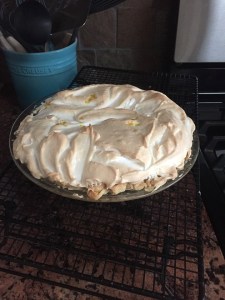
Pie:  We are a family of pie lovers. Favorites may vary from individual to individual but somewhere in our DNA is a “pie-lover” gene. My mother taught me to make pie crust. To her,  pie-making was an art form. I learned from her to treat the crust gently and carefully – don’t overwork it or the crust will be tough; use only as much water as you need to make the dough hold together and make sure the water is ice cold. She was a master craftsman.

When Fletcher wanted to bring a girl home from college to meet us I told him to find out what her favorite dessert was and I would make it for her. “It’s Coconut Pie”,  he told me. “Wow!  What are the odds?” I asked him. “You really do have a a lot in common!!”  And so every time she came for a visit we had Coconut Pie. It wasn’t until many years later at their rehearsal dinner I learned the truth. Emily’s mom wanted to know what the deal was with Coconut Pie. I explained I made it every time she came since it was her favorite dessert. “Actually, I don’t think she had ever had it before she came to your house.”  As I said – it’s in his genes.  He may also be a little manipulative.

pie 4

Paul’s mother made three chocolate cream pies every report card day.  That way if you got good grades you could celebrate. If you got bad grades, you had a way to drown your troubles. My mother made him chocolate pies every time we came for a visit and threatened if there was any left, she threatened never make another one for him. He always rose to the challenge.

312690_10150418300256311_870590329_n

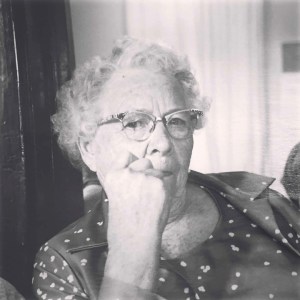
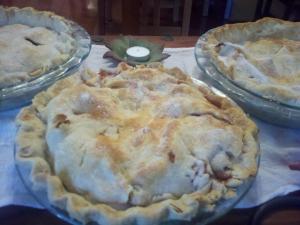
And then there were the Apple Pie Baking Marathons. When the older kids were little, every fall Grandma Fletch would come for a month-long visit. She cooked and baked and told stories and loved us well. One of our days we spent at a nearby orchard. We picked apples – bushels of apples – and returned home to roll up our sleeves and get ready for the days long process of pie baking. She set up an assembly line. Everybody had a job to do:  washing the apples, peeling and coring and slicing, combining  the sugar and cinnamon and then mixing it all together in a big bowl with the fruit. Grandma was always in charge of the pie crust. After several days we would have dozens of pies: baked, wrapped and ready for the freezer. All year long, anytime we wanted a special dessert, we could go to the ancient chest freezer in the garage and pull out a pie to stick in the oven and soon the house would be filled with the buttery, cinnamony, apple aroma that took us back to the way the house smelled on those days we worked side-by-side next to the Master Pie Baker herself and created all that deliciousness. For years after she was gone, we kept the ritual.  We went to the orchard on a crisp fall day, picked the apples, and formed our assembly line just as she had taught us to do. The year we stopped was the day it was time to go apple picking and there were still pies in the freezer. The family was shrinking and we no longer had the mouths to feed or the laborers.  But anytime I smell apple pie, I can still see us all in the kitchen with Hazel, each doing our job.  

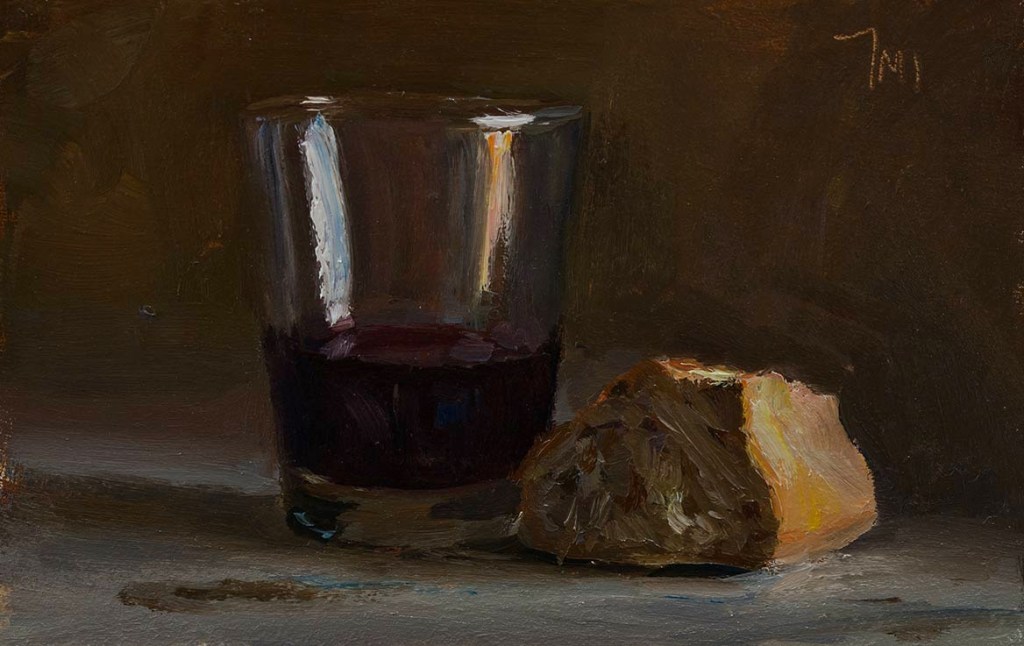
Bread and Wine: I have begun to feel that gathering at the table, sharing food and drink and sharing stories is a sacred experience.

When his followers asked him, “Teach us to pray”, Jesus included this:  Give us today our daily bread. Maybe this is about more than just nourishment for our physical bodies; maybe it is also about the table where we gather to tell our stories, nourish our souls and remember who we are.

I am struck by how many stories about Jesus are about the table. He goes to dinner parties with outsiders and undesirables, he performs his first miracle at a wedding feast, he provides a picnic for 5,000 people on a hillside, he cooks dinner for his friends on a beach, and 2,000 years later we are still telling those stories.

And then there is this: knowing he was going to die, he sat down around a table to share a meal with those who had shared his journey and would continue on without him. Because that’s what the family does in such a time. He washes their feet and cares for them with such love and affection. Around that table of special foods filled with such rich meaning, they remember and retell the story of the Jews miraculous exodus from Egypt and God’s faithfulness. But before the meal is over,  he will take the bread and the wine from that same table and use it to explain to them the hard truth of what is to come:  the bread is his body which will be broken for them and the wine is his blood which will be poured out to forgive the sins of many. They had no idea what it meant. Or what was to come.

But we do know. He left us this gift of symbol and remembrance and ritual. And time after time, we gather and remember and retell the story.  “As often as you  do this,” he said, “do it in remembrance of me.”  Jesus, too, knew the power of story, of remembering and of gathering around a table.

Perhaps, in the end, that is the real reason we are here.

FullSizeRender 34

Traditions: Where the Stories Live

I am seven. Or ten. Or thirteen. And all of the years in between and the ones that will come after. There she sits in a chair in the middle of the kitchen with the yellow bowl in her lap and a fork in her hand and she is beating the egg whites. She whips them until they are stiff and stand up in peaks. I asked her once if I could help and she let me try it, but I quickly tired of the task and gave it back to her. Did we not have an electric mixer? Or even a hand cranked egg beater?  I think maybe we did.But this task she chooses to do by hand. Because that is the way she has always done it and for reasons only God (and she) know, it is the way it should be done. When they are stiff enough to suit her she will mix them with the cooked sugar and syrup mixture and beat it some more and after a long and arduous process, the end result will be a Christmas candy that was a tradition in my family. Divinity. Too sweet for my taste,  I didn’t like it then and I don’t like it now. But I loved sitting in that warm kitchen on a winter night, hypnotized by the rhythmic beating of the eggs and my mother’s voice telling me stories of my family and my history.

I learned about the year that she and my sisters spent a whole day making this time-consuming, labor-intensive treat only to have my brothers come in from their farm chores and devour the whole day’s worth of work. Now they would be required to spend  another entire Saturday with a fork and bowl of eggs. And so, as they sat there on their kitchen chairs, taking out their frustration on the egg whites in front of them, my sisters hatched a plan. They would hide the fruit of their labor someplace where the boys couldn’t find it and bring it out only on Christmas Day. They knew the perfect hiding place – the elephant cookie jar that sat atop the pie cupboard. As the story goes, the boys looked high and low for that divinity but apparently never thought to look for candy in a cookie jar. Which I always thought didn’t speak too highly of my brothers’ intelligence or scouting abilities . . . but what do I know? At any rate my sisters were delighted with themselves and so every year after they made the divinity under my mother’s careful supervision, sneaked it into the cookie jar, and there it lived until they produced the treat for the family on Christmas Day. When my mother died and we were dividing up her things, my sister Minnie said the only thing she really wanted was that cookie jar – to remind her.

I learned about the war years when sugar was rationed and so there was no candy-making and really no Christmas once word came of my brother: missing in action. Her voice grows quieter and she seems further away and finally there is only the sound of the whirring fork against the sides of the glass bowl, turning the egg whites into divinity.

Some traditions I took with me from my childhood and incorporated them into  our own family’s celebrations.  Divinity was not one of them.

Some of our holiday traditions came from Paul’s family: chili and cinnamon rolls on Christmas Eve. Long after the rest of his family had moved on to other menus, we held fast.  And now most,  if not all,  of our children celebrate Christmas Eve with chili and cinnamon rolls.

img_8908
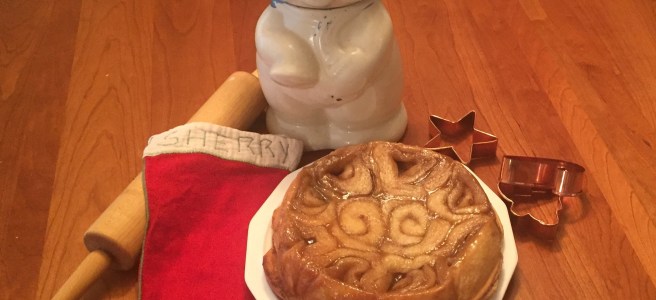
I inherited my mother’s rolling pin and her secret for cutting cinnamon rolls – use thread instead of a knife.

Some traditions we stumbled upon ourselves. The movie on Christmas Eve afternoon was birthed from a need to keep little people distracted and occupied through the long day before Christmas. Taking four little ones to see Cinderella in a real movie theatre and sitting in the front row and watching the three year old talk back to the characters and interact with the story on the screen is one of my  favorite Christmas memories. As the step sister assures the prince that it is indeed her slipper, the heroine’s young  advocate in the front row jumps to her feet: “She’s lying!!! She’s lying!!! It’s Cinderbrella’s”  and the whole audience cheered.

The Advent Calendar grew out of the need to bring structure to the growing list of all the Advent activities as we counted down the days. Who knew what secret delight one would find on the piece of paper with a 20 written on it or a 12 or a 15?  Maybe it will say “today we decorate the tree” and it turns the whole day into an event. Or maybe it is “go Christmas shopping” and you load up in the car and go to the discount store and find some awesome treasure for every member of the family – if you are the youngest you will be directed to the rolls of  Lifesavers that come in a box that looks like a book because that’s what the youngest always gives to the siblings. When you find “wrap Christmas presents” on the slip of paper, you head off to your own corner with your bag of treasures, a roll of paper, some scissors and a whole roll of tape all to yourself. Of course not every day was something big – sometimes it was the “filler” – the standby for when Mom & Dad hadn’t had time or foresight to plan an activity or come up with something creative: “get a candy cane off the tree”. Oooohhhhhh nooooooooo. And yet. As one of them explained many years later as an adult – “You do know, right, that NONE of the six of us liked peppermint?”  But because it was in the Advent Calendar that made it special enough that you took your candy cane, ate it, pretended it was a good thing, and hoped tomorrow would bring something better. And sometimes it did.  Like the little Snoopy notepads with little pencils in a little bag.  Jackpot!

1017171_10151949126111311_2088027134_n

It’s a little sad the day you realize that some of the traditions you initiated for your young family when you were doing campus ministry no longer work. In those days, all the busyness and craziness came to a screeching halt the week before Christmas as students finished their last exam and  left for home and you were left with that most precious of all commodities: time. But then those days give way to a healthy and thriving community church with three Christmas Eve Services and there is no time for Christmas Eve movies or chili and cinnamon rolls. But you adapt. You replace a movie with a breakfast at Waffle House and leave a $100 tip for your waitress who one year is a single mom and hasn’t been able to buy a Christmas present yet for her daughter and you offer a little prayer of gratitude for the opportunity to be a part of this. One year your waiter is named Jack and you learn that he is working on Christmas Eve because he wants to make as much as he can so that he can really party it up on New Year’s Eve and with a sinking feeling you realize where your tip money is going to go, but it leads to a new tradition of toasting Jack at every family gathering. You move the chili and cinnamon rolls to Christmas Day (and alleviate the need to fix a big Christmas dinner that nobody wants to eat anyway – a win/win) and you pass along your Advent Calendar to a young family who is glad for the excitement and anticipation it brings to their home. And life goes on. New traditions are born as old ones die off. . .  but the stories. The stories live forever – if they are told – and they bind us both to those who came before and those who will come after

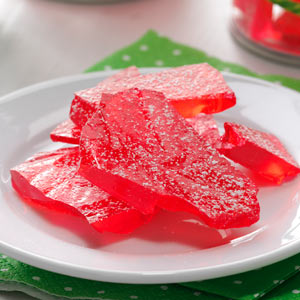
Because here’s the thing. I don’t make divinity. I make (or more accurately made) cinnamon hard candy – the hotter the better. This, too, came from my childhood.  And now my daughter makes it and when she brings it we all eat it and say to each other – “it tastes like Christmas”.  She makes “Skyline Chili” for her family on Christmas Eve because that is her husband’s tradition. . .  and so it goes.

exps13214_ck133085b06_18_1b
I remember that we bought the cinnamon oil at Potter’s Drug Store. They kept it behind the counter and you had to ask the pharmacist to get it for you which gave the whole process some level of intrigue  – like we were using some sort of contraband ingredient.

But the stories live on and are passed on and they matter. The traditions can change and  adapt and evolve. It’s the stories that ground us and remind us who we are, where we come from, and why we’re here. That’s why I keep the elephant cookie jar  (which eventually found its way to my kitchen) on top of my cabinet.  I don’t hide divinity in it. . . actually I don’t use it all.  But as the keeper of its story, I feel a responsibility to care for it and the memories that live there.

img_8915