Ministry has always been a part of our story. A big part. For the last 33 years it has been the ministry of Cedarbrook. As this chapter comes to a close, there are two stories that should be told.
We met Johnnie Benton the day we walked into a Classical Rhetoric class at Southern Colorado State College in 1969. We were both speech majors and this was a required course.
Dr. Benton was sarcastic, cynical, outspoken and disapproving of most things – particularly anything religious. He mocked, challenged, scoffed at and belittled anything having to do with faith. He was a self-proclaimed apostate and had renounced not just the fundamentalism of his youth but all things associated with the church, declaring that all preachers were hypocrites, charlatans, or just too stupid to realize that what they were preaching could not possibly be true. But in his eyes, their most egregious sin was that he found them to be terrible communicators. So you can imagine his disgust and his dismay when he discovered that one of his favorite students iin the speech department was planning on going into ministry.
“You’re too smart for this,” he told Paul. “You’re an analytical thinker with a good mind and the ability to see both sides of an argument. What the hell are you thinking?”
But the student could not be dissuaded. So finally Dr. Benton said, “Okay, then. If you’re going to do this, then you’re going to be good at it.” And he set out to make this student not just a passable public speaker, but a really good one. And while the professor would not have been anybody’s choice to mentor a future pastor when it came to theology or building strong character, I would argue that there was no one better to mentor him in writing and delivering a sermon. He gave him the toughest of assignments and graded him mercilessly. When he detected even a hint of BS or trump-ta-tra, he called it out. His first response in critiquing a speech was to ask with a smirk, “”So what?” Meaning – why should I, the listener, care about what you just said? How does this relate to me? He taught that it is the listener, not the speaker, who is the most important person in communication and it’s the job of the speaker to find and make the connection. I sometimes think of Johnnie Benton when people say to Paul on any given Sunday morning, “I felt like you were talking just to me.” And I know of course, that it’s the work of the Holy Spirit, but I also think maybe that mean ole’ cuss of a professor played a part in it as well.
And then there was Mr. Chmel, the high school drama director. I did theatre in high school – it was one of my things. I even started out as a theatre major in college. I liked being somebody else – creating a character that was nothing like me and living inside that person for a while and bringing her to life. Paul did NOT do theatre. For a good reason. He could not act. Not even a little. But in our senior year, Mr. Chmel was short of males for the play he had selected and he asked Paul to take a role. Paul told him, ” I can’t act.” But you’d only have like three lines.” Nope. He was not interested. So Mr. Chmel told me to ask him. “If you ask him, he’ll do it.” I don’t think so, I said. He can’t act. But I asked. “It could be fun to be in one play together before we graduate – we could go to rehearsals together and the cast party. It’ll be fun. ” He grudgingly agreed. Poor Mr. Chmel. He probably spent more time with Paul working on those few lines than he did with the rest of the cast put together. At the cast party he said to me, “You were right. He can’t act.”
I say all that to say this: with Paul, what you saw is what you got. It wasn’t a show. It wasn’t an act. He wasn’t playing the role. He never pretended to be someone he’s not to build a bigger church. He doesn’t even know how to do that – it just isn’t in him. He is the same person at home that he was when he stood before the church. He treats the servers at McDonalds the same way he treated you when you talked to him in the lobby after the service. In this day of “The Celebrity Pastor” and all the heartache and grief and shame that has brought to the Church, Paul was simply who he was. You may not like who he was and you may have wanted a pastor who was more extroverted, more charismatic, or just more. But he didn’t know how to play that role. God knows he isn’t perfect and there are a myriad of things he would do differently if he could go back. But he wasn’t acting – he brought his true and authentic self – for better or worse.
Paul, thank you for bringing me with you on this adventure of a lifetime. For all of our starts and stops, all the things that we got wrong and those times we succeeded in spite of ourselves and only by the grace of God, we have been partners through it all. I am forever grateful. And for the record, I think over the years you have preached a handful of sermons that would have made Johnnie Benton proud.
“There is a difference between curing and healing, and I believe the church is called to the slow and difficult work of healing. We are called to enter into one another’s pain, anoint it as holy, and stick around no matter the outcome.” Rachel Held Evans
When Paul proposed in January of 1969, he did it without an engagement ring. That is another story and one that is told in the story called The Proposal. But this is a different story.
The day after we graduated from high school, Paul got in a car and drove to Denver where his Dad had moved earlier in the year for a job. He got a job in the same bakery where his dad worked and eventually would land a second job at the Leaning Tower of Pizza (yup, that was really the name of it). The rest of the family stayed in Pueblo to finish out the school year and over the summer, they would all relocate. I stayed in Pueblo for my job. We wrote letters back and forth every day and I penned mine on stationary that I had purchased with some of my graduation money – a box filled with bright neon orange and green and yellow sheets and matching envelopes. He used a yellow legal pad with white envelopes (once a debater, always a debater). They were love letters of sorts and also a daily journal of what we had done that day and whatever it is that eighteen year olds write to one another when they are falling in love. I wish I still had them.
I say all that to say that even after working two jobs all summer and putting in lots and lots of hours because he had nothing else to do really, at the end of the summer he had no money to show for his efforts. Not because he spent it all on himself, but because his family was struggling financially trying to get moved and established in Denver, and Paul signed over his paycheck to them every week. That, with what his dad was bringing home, kept the wolf from the door until they could get on their feet.
He returned to Pueblo at the end of the summer to start school at the local college where we both had full scholarships and got a job at Sears selling paint to pay for gas to get back and forth to class from the home of a family friend who boarded him for free.
In December he returned to Denver to spend the holidays with his family and when he came back for the second semester we got engaged.and set the wedding for September. And yes, I know., We were too young, we were too poor, we were too stupid, we were too. . . . But that’s the way the story goes.
I think it must have been sometime in the spring, maybe over Spring Break, we went to Denver to visit his family. His mother wanted to go to the mall, and usually when Judy made a plan, it was going to happen. So we were walking through the mall, window shopping and visiting and at some point we ended up at the Sear’s jewelry counter. His mother stopped to look – she loved jewelry! I think I wandered off in a different direction to look at sweaters or some such thing and she called me back. She was pointing at engagement rings. “So when you get a ring, what kind do you like?” I hadn’t really thought about it. “Well. . . I like white gold,” I offered. “But what STYLE do you like?” I wasn’t sure what to say. “Do you like that one?” Not really, though I could’t really give her a reason. “What about that one?” Uuummmm. . . it’s okay. “That one?” No. “How about that one?” Yeah. I do sort of like that. She got the sales clerk’s attention, “Can we try that one on?” I put it on my finger. “What do you think?” she wanted to know. I thought it was pretty. “Okay, we’ll take it,” she told the clerk. And just like that, I had picked out my engagement ring. Had I known we were actually going to buy a ring that day, I’m not sure it’s what I would have chosen. But I did like it well enough. Looking back, I know we went to the mall that day to get a ring, and when Judy makes a plan . . .
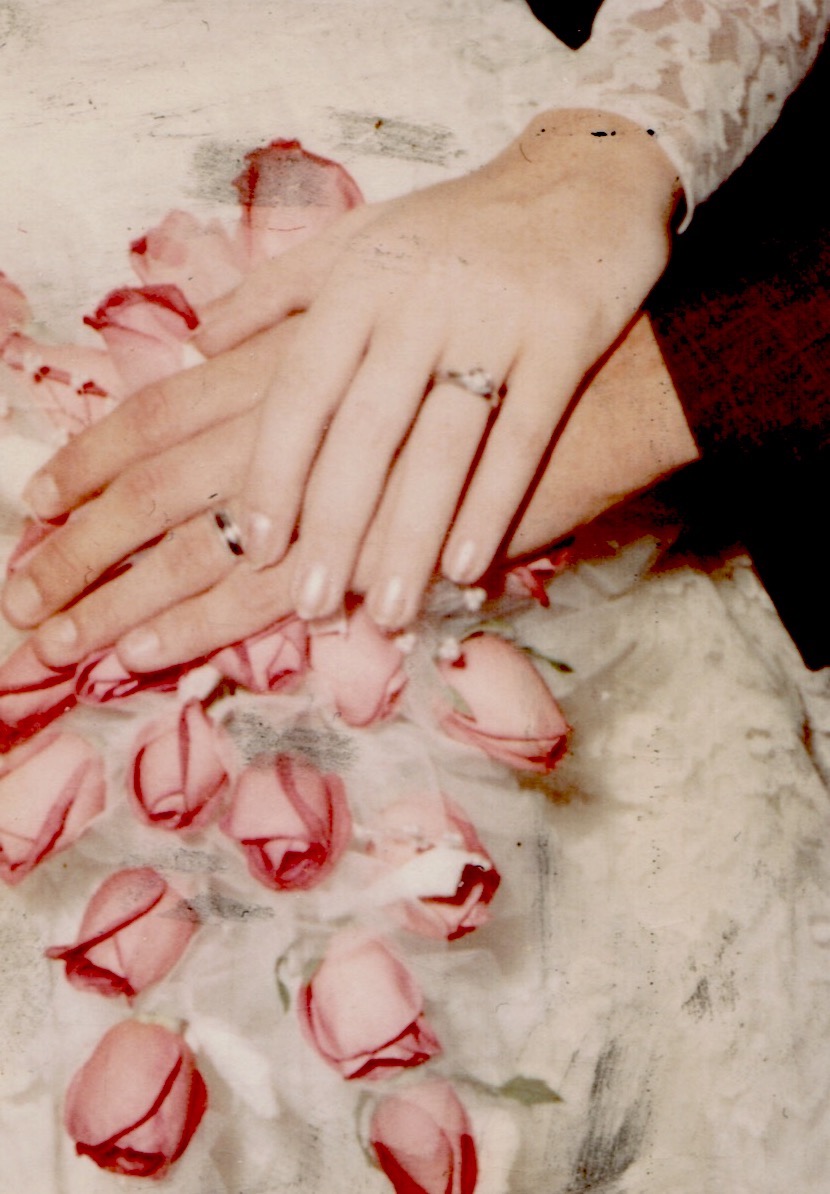
Over the years, I wore it and the plain matching wedding band without really giving it much thought or notice. I wore it when I kneaded bread and when I bathed babies. When I washed dishes and when I folded laundry. When I slammed the door after a fight about who knows what and when I caressed his face and said, “I’m sorry “. When I taught my little ones to hold a pencil and when I walked down the street holding hands with the one who had put it on my finger at the altar. I wore it when I wiped away tears from little faces and from my own and when I served up ice cream floats to college students as we sat on the front porch on hot summer nights.
And then one day, about 20 years later, I looked down at my hand and the diamond was missing from the ring. It was not a big diamond, but now there seemed to be a huge gaping hole where the stone should have been. I had no idea how long it had been missing or when or where I lost it. I only knew it was gone, and I was devastated. All of a sudden the ring that had not mattered, mattered so much. Money was tight and while Paul wanted to get the stone replaced, I insisted that we should just get plain bands and wait on a diamond . . . so that’s what we did. For twenty years, we wore plain gold bands and I told myself it was way more practical anyway. Paul continued to wear his original band on his right hand and sometimes people would ask him why he wore two wedding rings. “This one is from my first marriage,” he would say. I wore my mother’s engagement ring and wedding band on my right hand which is another story for another day called The Fellowship of the Ring but also worth reading.
And then on September 5, 2009, on our 40th wedding anniversary, Paul had a gift for me. He put a black velvet ring box in my hand. I thought maybe he had bought me an anniversary band. When I opened it, there was my ring. With a new stone in it. And yes, I cried. He was explaining he had wanted to replace it with a bigger diamond but it would need a new setting to do that and that would have been more expensive. And that he was sorry the diamond was so small, and he wished it were bigger and maybe he should have just gotten a new ring altogether. How could I explain to him everything this ring meant to me after 40 years?
That this ring told the story of not just his love and his care for me, but for his parents and how he had spent all his summer wages to help them. That I had learned that a man who would care for his parents like that would care for his wife and sacrifice for her which he had done over and over and over again. It told the story of my mother-in-law and her generosity and her love and care for me. It told the story of our marriage: that it had never been built on money or expensive things but on love and commitment and our promise to one another. That ring, which had cost $160 in 1969, held so many stories. It was irreplacable. No, I did not want a different ring.
And now, as our 50th anniversary approaches (but how can we have been married 50 years??!!), Paul made a plan – he is his mother’s son. He wanted to put a bigger, better stone in the ring. “Because,” he said, “fifty years is a really big deal.”. I agreed. Fifty years is a big deal. But only if they could put it in the original setting and make it work. So we took it to a jeweler who helped us to choose the right stone and will repair the crack in the band and give it back better than new. And now this will become part of the story as well.
Side bar: A couple of years ago, I had a minor surgery which required general anesthesia. Following the doctor’s directions, I removed all my jewelry and left it on my dresser before I went to the hospital. I got all the typical warnings and instructions before I returned home: don’t drive, don’t operate heavy machinery, don’t sign any documents or make any major decisions, don’t use the stove. etc. When we returned home, Paul deposited me on the couch, and went across the street to get me a salad. He was gone maybe 15 minutes. During that time I saw my jewelry on the dresser and decided it needed to be cleaned ( I have NEVER cleaned my jewelry before in my life) so I took it all to the bathroom, plugged and filled the sink, slathered it with jewelry cleaner, washed it all off, dried it off, drained the sink, and put it back on – earrings, necklace, bracelet, etc. A few minutes later I noticed I was not wearing my wedding ring. I retraced by steps, looked all over the counter, and decided it must have been in the sink when I drained the water. About this time, Paul returned home. “We have a small problem,” and I explained the situation. “But all we need to do is take apart the pipe under the sink, and there it will be. Easy peasie.” The problem was, it wasn’t in the pipe. I could feel the panic rising. Paul said maybe he could disconnect the pipe in the basement and find it that way. Nope. Full blown panic was setting in. I was in tears and could not be comforted. Paul sat on the bathroom bench next to me: “It’s okay. It’s just a ring. We can get another ring. It’s just a symbol. We are the real thing. And we still have each other. That’s the important thing.” By now I was wailing. “NO!! THE IMPORTANT THING IS THAT WE FIND THAT RING! I HAVE HAD THAT RING FOR ALMOST 50 YEARS AND IT’S IRREPLACEABLE!” Okay, so maybe the hysteria was coming from the drugs still in my system. . . but still. . .
I could hear Paul in the living room calling plumbers, It was after 5:00 so it was hard to get anybody to answer. but he was trying. To calm myself, I stood up and began aimlessly moving things around the bathroom counter. And there, carefully tucked under the soap dish where I had obviously put it for safe keeping but had no memory of doing so, was my ring. That which had been lost was found and now I cried uncontrollable happy tears (didn’t Jesus tell a story something like this?).
Like a marriage of 50 years
Two lessons to learn from this chapter of the story: (1) Always follow your doctor’s instructions after anesthesia, though in my defense nobody said anything about not cleaning your jewelry and (2) The worth of an object is not always measured by monetary value but by the stories we attach to it. Some things are irreplaceable.
“There are things you do because they feel right & they may make no sense & they may make no money & it may be the real reason we are here: to love each other & to eat each other’s cooking & say it was good.”
It is one of my favorite Story People stories. We have it framed and hanging on our “family wall” in our living room. I think it belongs there because food is a part of every family’s story whether we recognize it or not – or at least it is a part of our story.
It’s the story behind Crescent Rolls and Chicken & Noodles. Canned Jellied Cranberry Sauce and Donuts. Chili and Cinnamon Rolls. Tuna Noodle Casserole and Vegetable Soup. Coconut Pie and Apple Pie made from orchard apples. Bread and Wine.
My mother was the best cook of anyone I have ever known. I, on the other hand, got married barely knowing how to boil water. Paul always thought it was a bait-and-switch: he came to my house, ate my mother’s cooking and just assumed it was a genetic thing and this is what he could expect when we were eating out of our own kitchen. It was a hard adjustment for him – we ate out a lot and went to my mom’s house once a week for dinner. But slowly I began to take an interest and figured some things out.
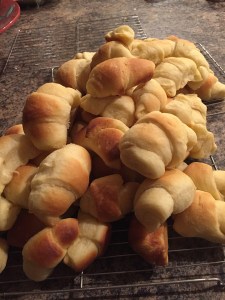
Crescent Rolls: On our first son’s first birthday, I wanted to do something special. So I opened my Better Homes and Gardens Cookbook I had received from my niece as a wedding gift with the inscription that read: “Dear Paul, good luck. You’re going to need it.” I found a recipe for Crescent Rolls. Perfect! How hard could this be. Turns out . . . pretty hard. It was a time-consuming recipe which took most of the day, but so worth it! Over the years I tweaked the recipe to my liking and they became a “must have” for holiday meals. The story is still told about the year that “one of us” set his alarm and rose at 5:00 a.m. on the day after Thanksgiving to eat all the leftover rolls before anyone else could get to them – in a big family one must learn to out-wit, out-play and out-last the competition. We’ve had some glitches along the way. There was the year I forgot to set the timer and burned the bottoms to a blackened charcoal on the Wednesday before Thanksgiving. So we cut the bottoms off, slathered them with butter and called it dinner that evening. Then I set to work on the next batch which took me late into the night. There were years the yeast didn’t rise because the milk was too hot or not hot enough and I had to start over. But if you come to our house on Thanksgiving or Christmas, you will get Crescent Rolls.
Chicken-and-Noodles: In those early years as I was expanding my repertoire I asked Paul, “What did your mother cook that you really loved.” He fired back, “Home-made Chicken and Noodles!!” So I made the long distance call to his mother to get the recipe and set out to wow him. I followed exactly the recipe my mother-in-law had copied from a newspaper column decades before. When it said, “Roll the dough very thin and cut into strips,” I labored with my rolling pin, stretching and rolling and pulling and rolling until the dough was indeed paper-thin. It was a labor of love, if a frustrating exercise, but I was determined to replicate his mother’s dish. I sat down to dinner ready to bask in his awe and admiration and gratitude. “What is it?” He stared into his bowl of paper-thin, perfectly cut noodles swimming in broth. Are you kidding me? It’s Chicken and Noodles! “No” NO??!! “Well, it’s not my mother’s chicken and noodles.” So I got up from the table to make another call. “I followed the recipe exactly and he says I didn’t get it right? What happened.?” I could hear the commotion in the background as she was rushing to get dinner on the table for the six kids still at home. “Read the recipe back to me,” she said over the din of two kids arguing over whose turn it was to the set the table. When I came to the part about rolling the dough paper thin, she interrupted me. “Oh good grief, Sherry! I never had time to mess with that nonsense. Just give it a few swipes of the rolling pin and call it good!” Okay then. And so now my own family thinks if the the noodles are not thick and almost chewy with a thick broth and huge chunks of chicken – then it’s not really Chicken and Noodles. Following a recipe can be so over-rated.
Jellied Cranberry Sauce: As I honed my skills in the kitchen I developed an attitude that “made- from-scratch-is-always-better” and so cranberry sauce should be made with fresh cranberries and a zested orange. Truth be told, nobody ever ate it but me, but that’s how I did it. Then our son-in-law joined the family and when we sat down to Thanksgiving dinner his first year he asked for the cranberry sauce. It was passed around the table to him. Nope. He was looking for the jellied cranberry sauce that comes out of a can. Now, every year, he gets a whole can of it to himself, and I eat the other. And everybody goes home happy.
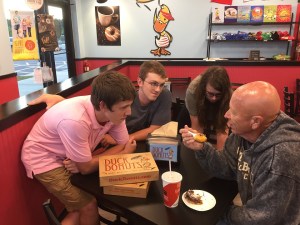
Donuts: We were at the beach and Paul and I were headed out to the grocery store. I called out “Does anybody need or want anything from the store?” The four year old grandson never looked up from his Lego’s. “How ‘bout donuts!?” he yelled. And now, twelve years and eight grand-kids later, you haven’t been to Nana & Colonel’s until you’ve gone for donuts. The littles always love to hear how, when we were first married, Colonel was the guy who made the donuts at Dunkin’ Donuts and could eat all the donuts he wanted every night. I know, it’s not hard to impress them when they’re young.
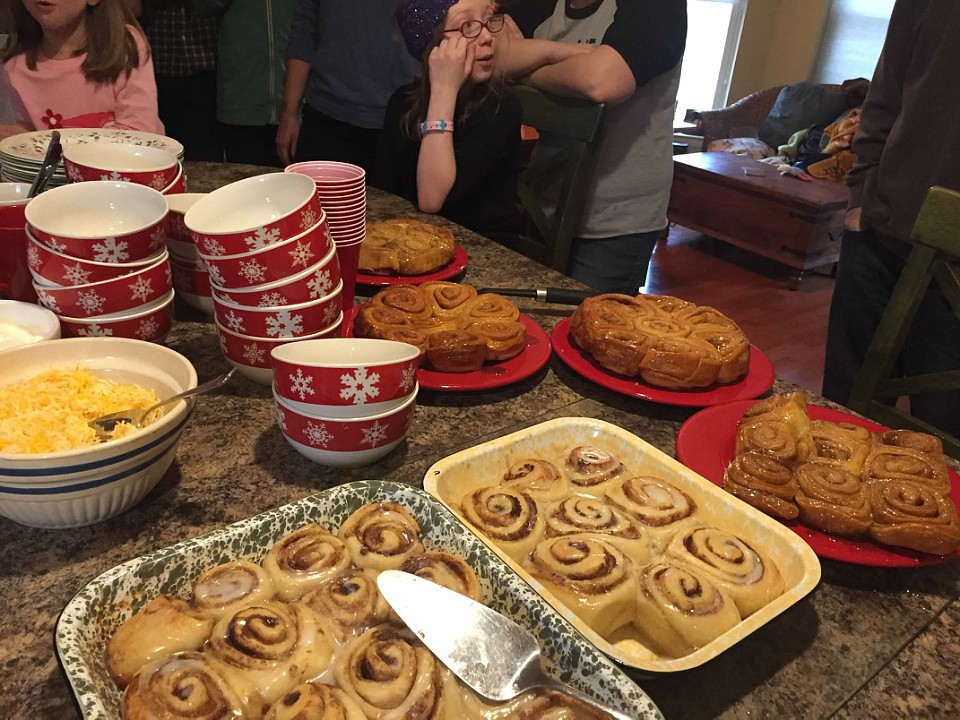
Chili and Cinnamon Rolls: In both our families, the traditional Christmas Eve dinner was soup. At the Abbotts it was Chili. At the Fletchers it was Chile and Potato Soup and Oyster Stew. At the Fletcher’s it was Cinnamon Rolls and Potica (a wonderful Slavic Sweet Bread introduced to our food culture by my brother-in-law’s family). At the Abbotts it was Cinnamon Rolls and since I never mastered the art of Potica making, we stick to the Cinnamon Rolls. There was the year that I got distracted in the making and instead of dividing the dough into halves to make out the rolls I divided it into thirds and ended up making more, but much smaller rolls. I didn’t realize my mistake until one of the kids who was home for the holidays said, “It’s funny, when I was a kid these rolls seemed to be so big they filled your whole plate and now it seems like I could eat three of them,” Yup, pretty much. The year our son was in Iraq we sent a can of Hormel Chili and a box of Honey Buns in his Christmas package. In some way or another, I think most of the kids have carried on the tradition and live out the story.
Passing down the story from generation to generation.
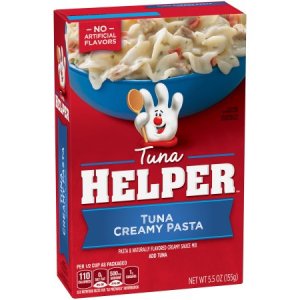
Tuna Noodle Casserole and Vegetable Soup: Like most families, in ours you got to pick the dinner menu on your birthday. When our youngest was little, his favorite meal was Tuna Noodle Casserole. Nobody else really liked it so we rarely had it, but on his birthday he got to choose. One year he was spending his birthday with some family friends because Paul and I had to be out of town. Peggy asked him what he wanted for dinner. Tuna Noodle Casserole – of course! “Does your mom have a special recipe she uses?” Having five kids of her own she understood the risk of making something that was not like Mom’s. “Yes, she does. It’s on the back of the box.” And though her own kids gagged on it, she made Tuna Helper straight from the box and Fletcher was delighted. Clearly by the sixth one I had abandoned the “made-from-scratch-is-always-better” ideology.
Tabithas’s request was always Vegetable Beef Soup – preferably without the beef. The other kids groaned – what kid really LIKES soup? But that was what we had every March 4th. Even on the years that spring came early and we were eating soup with the air conditioning on. The one thing that redeemed her choice is that she always asked for Boston Cream Pie, and who doesn’t like that?
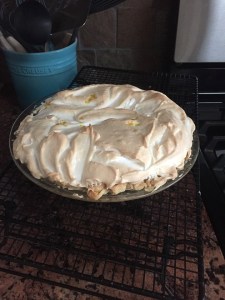
Pie: We are a family of pie lovers. Favorites may vary from individual to individual but somewhere in our DNA is a “pie-lover” gene. My mother taught me to make pie crust. To her, pie-making was an art form. I learned from her to treat the crust gently and carefully – don’t overwork it or the crust will be tough; use only as much water as you need to make the dough hold together and make sure the water is ice cold. She was a master craftsman.
When Fletcher wanted to bring a girl home from college to meet us I told him to find out what her favorite dessert was and I would make it for her. “It’s Coconut Pie”, he told me. “Wow! What are the odds?” I asked him. “You really do have a a lot in common!!” And so every time she came for a visit we had Coconut Pie. It wasn’t until many years later at their rehearsal dinner I learned the truth. Emily’s mom wanted to know what the deal was with Coconut Pie. I explained I made it every time she came since it was her favorite dessert. “Actually, I don’t think she had ever had it before she came to your house.” As I said – it’s in his genes. He may also be a little manipulative.
Paul’s mother made three chocolate cream pies every report card day. That way if you got good grades you could celebrate. If you got bad grades, you had a way to drown your troubles. My mother made him chocolate pies every time we came for a visit and threatened if there was any left, she threatened never make another one for him. He always rose to the challenge.
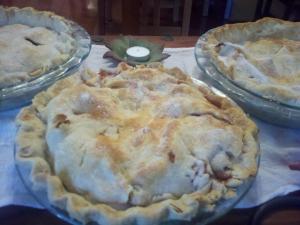
And then there were the Apple Pie Baking Marathons. When the older kids were little, every fall Grandma Fletch would come for a month-long visit. She cooked and baked and told stories and loved us well. One of our days we spent at a nearby orchard. We picked apples – bushels of apples – and returned home to roll up our sleeves and get ready for the days long process of pie baking. She set up an assembly line. Everybody had a job to do: washing the apples, peeling and coring and slicing, combining the sugar and cinnamon and then mixing it all together in a big bowl with the fruit. Grandma was always in charge of the pie crust. After several days we would have dozens of pies: baked, wrapped and ready for the freezer. All year long, anytime we wanted a special dessert, we could go to the ancient chest freezer in the garage and pull out a pie to stick in the oven and soon the house would be filled with the buttery, cinnamony, apple aroma that took us back to the way the house smelled on those days we worked side-by-side next to the Master Pie Baker herself and created all that deliciousness. For years after she was gone, we kept the ritual. We went to the orchard on a crisp fall day, picked the apples, and formed our assembly line just as she had taught us to do. The year we stopped was the day it was time to go apple picking and there were still pies in the freezer. The family was shrinking and we no longer had the mouths to feed or the laborers. But anytime I smell apple pie, I can still see us all in the kitchen with Hazel, each doing our job.
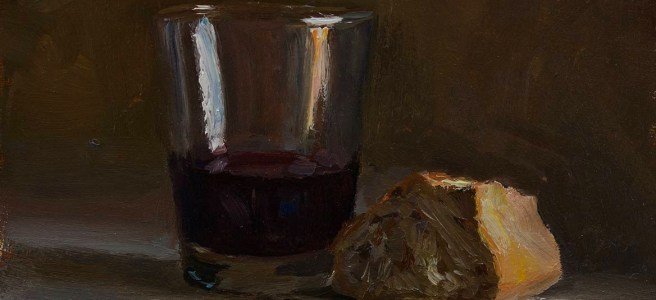
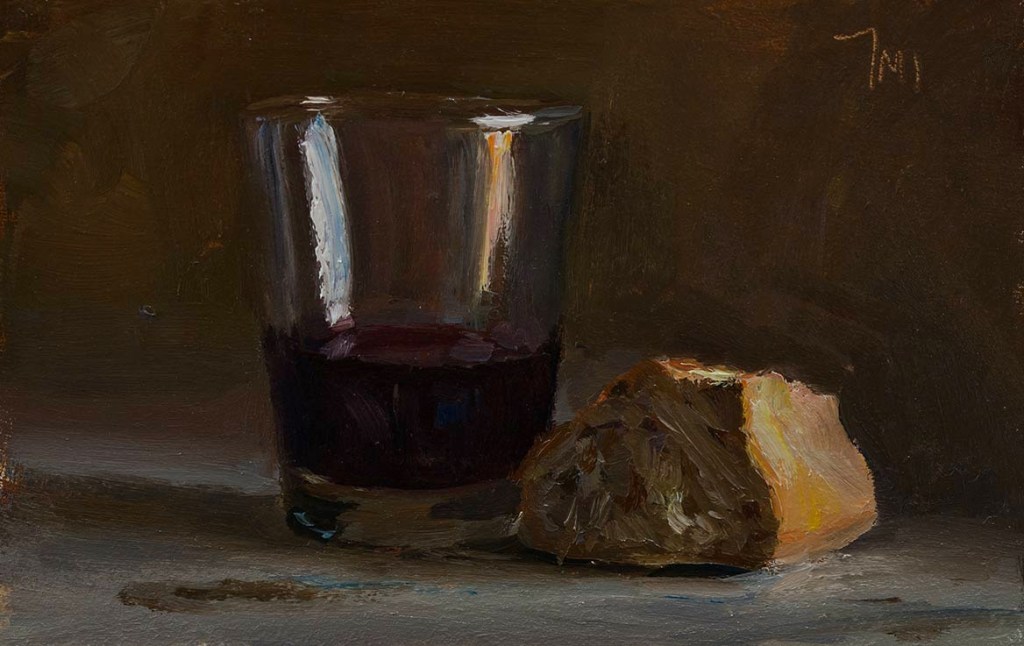
Bread and Wine: I have begun to feel that gathering at the table, sharing food and drink and sharing stories is a sacred experience.
When his followers asked him, “Teach us to pray”, Jesus included this: Give us today our daily bread. Maybe this is about more than just nourishment for our physical bodies; maybe it is also about the table where we gather to tell our stories, nourish our souls and remember who we are.
I am struck by how many stories about Jesus are about the table. He goes to dinner parties with outsiders and undesirables, he performs his first miracle at a wedding feast, he provides a picnic for 5,000 people on a hillside, he cooks dinner for his friends on a beach, and 2,000 years later we are still telling those stories.
And then there is this: knowing he was going to die, he sat down around a table to share a meal with those who had shared his journey and would continue on without him. Because that’s what the family does in such a time. He washes their feet and cares for them with such love and affection. Around that table of special foods filled with such rich meaning, they remember and retell the story of the Jews miraculous exodus from Egypt and God’s faithfulness. But before the meal is over, he will take the bread and the wine from that same table and use it to explain to them the hard truth of what is to come: the bread is his body which will be broken for them and the wine is his blood which will be poured out to forgive the sins of many. They had no idea what it meant. Or what was to come.
But we do know. He left us this gift of symbol and remembrance and ritual. And time after time, we gather and remember and retell the story. “As often as you do this,” he said, “do it in remembrance of me.” Jesus, too, knew the power of story, of remembering and of gathering around a table.
Perhaps, in the end, that is the real reason we are here.






 because our stories matter