We both had red hair – a dark auburn really. Much like our mother’s, I think. She had brown eyes; I had blue. We grew up in the same family; sort of. She lived out her childhood in a family with both a mother and a father in the home, surrounded by four siblings only a few years older than she. From the age of four, after my father’s death, I grew up in a home with a single mom and her: a sister seventeen years older than me. She was born in the middle of the Great Depression and I was born at the beginning of what some called the Golden Age – the 1950’s. We shared a home, a family background, and genetics but though I know ABOUT her, I really didn’t know HER. And that’s on me.


Her name was Lola Irene. I have no idea why she was given that name – maybe because my mother liked the sound of it. I do know that it wasn’t until years later that my mother realized she had done the very thing she disparaged my grandmother for. My dad’s name was Ray. He had a brother named Roy. My mother told me, “I wondered why anybody would be so stupid as to give two boys in the same family such similar names. It led to no end of confusion – for everybody!” Then one day – when it was too late to do anything about it – she realized she had done the same thing with two of her daughters: Lila and Lola. I think after that she always cut my grandmother some slack.
When Lola was five days old she contracted whooping cough. She ran a high fever for days and though my parents prayed fervently, they did not expect their baby to survive. They would not have been the first family they knew to lose an infant to one of the many diseases that every parent of that generation feared. But at last the fever broke; their baby had survived. It would not be until later that they would understand the aftermath: the high fever plus the whooping cough had caused brain damage resulting in permanent physical, intellectual, and developmental disabilities.
As a child, my sister often experienced petit mal seizures, though neither the doctors nor my parents understood what these were. They grew used to her “spells” as they called them: periods of time where she stared into space unseeing and unaware of her surroundings. Nobody thought much of it; maybe she’s daydreaming, they said. It wasn’t until she was 20 that she had her first grand mal seizure and was diagnosed with epilepsy. Though medication (which could have terrible side-effects) kept them somewhat under control for periods of time, these seizures would worsen and continue for the rest of her life and became debilitating and dangerous.
Our older sister Lila had moved from Nebraska to Denver a year out of high school to attend nursing school. There she met her husband and they settled in a town south of Denver – Pueblo, Colorado. I think it was in the fall of 1953, Lila brought her children home to the farm for a visit. Lola was sick and getting sicker every day with fever and terrible muscle aches. Lila insisted they take her to a hospital about an hour away. It was there they diagnosed her with polio and she had her first grand mal seizure which led to the diagnosis of epilepsy. It was a scary time for all of them, but once again Lola pulled through and though the polio left her limbs weaker, she suffered no paralysis. Because we are all shaped by our stories, I think this is the reason that I am a believer in vaccines. My sister Minnie’s husband also contracted polio as a teenager and as a result wore a brace and walked with a cane the rest of his life. Neither the whooping cough nor the polio vaccine were available to them; I’m glad they were for my children.

( top row far left) would be taken to the hospital and diagnosed with Polio.
I don’t know when I learned all of these details. Somewhere along the way, I’m sure my mother shared them with me to help me understand why Lola needed extra care and why she couldn’t do all the things other grown ups could. Why she couldn’t live by herself or drive a car or get a job. Why things that seemed easy and effortless to me were harder for her. Back then we used the word handicapped. Today we would say disabled, a term I have only recently learned the disabled community prefers to special needs. It’s interesting to me that so often terms that start out as a straightforward definition become loaded and stigmatized until they are avoided altogether and replaced with something new until later reclaimed by the community.
In 1954, after my father’s death, my mother moved with Lola and me to Pueblo where she could find work to support us while being near Lila. After the first year or so we bought a two bedroom house near the hospital where Mom had procured a job as a cook. My mother and Lola shared one bedroom and I had the other to myself. It never once occurred to me why this was the arrangement, and I never thought to ask. But now I wonder – how did that feel to a 22 year old woman to be sharing a room with her mother? But I never remember her complaining – though I’m sure if the tables had been turned, I would have raised all kinds of hell.
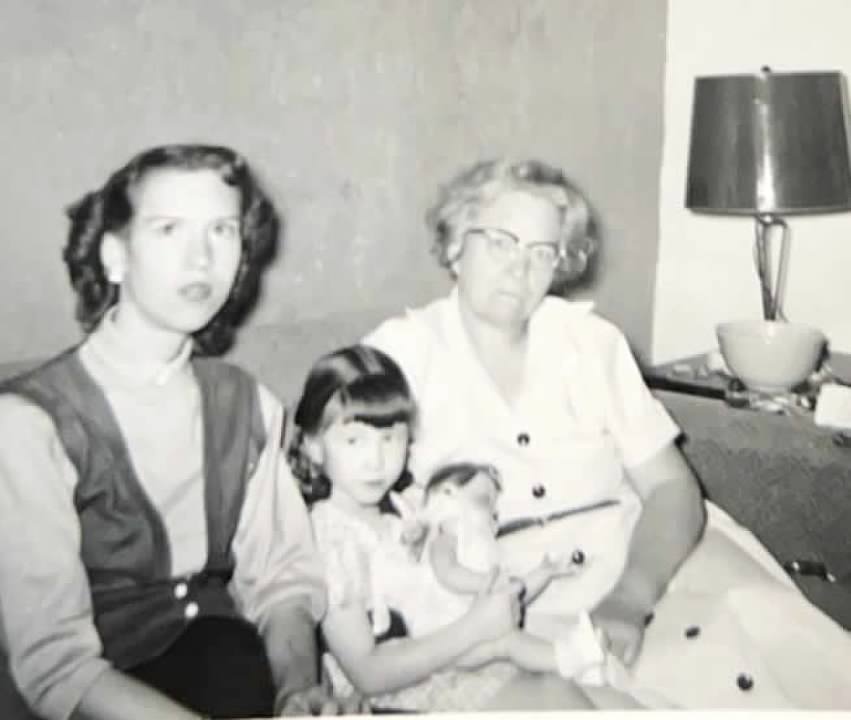
I remember there was a period of time when my sister had an unofficial job. She was a companion for a lady in a wheelchair and she would go to her house and fix her lunch and hang out with her so the woman, whose name was Esther, didn’t have to be alone all day. And sometimes from time to time I would go with her and we would put together puzzles and Esther let me use her typewriter and I felt so grown up. Did I ever tell my sister that? Did I ever tell her I appreciated that she let me do that? I don’t think I did.
Later she worked at the Goodwill. She seemed happy there. Maybe she felt like it was a real job and she was doing real work. She got a paycheck and money of her own and she made friends. I don’t know how long she worked there or why it ended. My guess is that the seizures made it difficult and my mother was anxious about it. I never asked her and we never talked about it.
The truth is, I don’t really remember talking to her much at all. As I got a little older I think I felt like we didn’t have much in common. I had my friends and my life and her life was so . . . different than mine. I couldn’t relate to her and I didn’t try and that’s on me.

I have very little memory of what anyone got me for a wedding present except this: Lola gave me a little Correlle teapot. She knew I liked tea. I have no idea how she knew that except she clearly paid more attention to me than I did to her. When I got married and moved out, I know that was a hard time for her – not because she missed ME really, but I think she felt like she wanted her own place and she wanted her own life, too, And she didn’t want to live with her mother forever. My mom knew her daughter could never live on her own and she would not put her in a “home” as she had seen others do with their “handicapped” children. But Lola persisted.
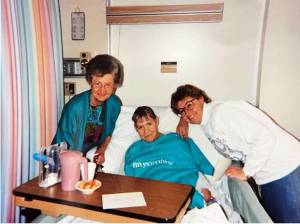
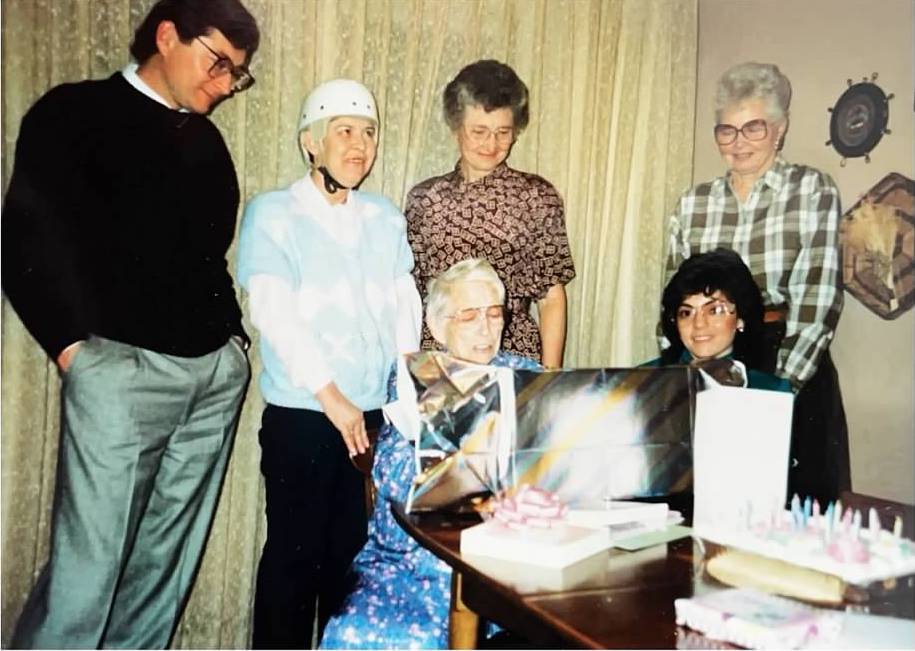
I don’t know it for a fact but I am guessing that it was Lila who persuaded my mother that Lola needed something different and that she deserved to live as independently as she possibly could. I’m sure there were also hard conversations where Lila made my mother come to grips with the fact that Mom would not always be around to take care of her daughter. . . and then what? So Lila started looking and they found a place in Colorado Springs – only 30 minutes away from Pueblo – where Lola could live in a little apartment but there were people there to look in and help when needed. And if the time ever came – which it did – that she needed more care, she could move into another wing where more supervision and care would be provided. It was the right call and even I knew she was happy in this place, surrounded by friends and activities she could be a part of. Lila and her family often visited, and she lived out her days in this way to the age of 60 – well loved and well cared for.
Out of all my siblings, Lola is the only one I ever shared a home with. I should have known her better than any of the others. But I didn’t. I simply didn’t take the time or make the effort to learn about her and her life. And I am the poorer for it. My mother used to say to me, “I don’t understand how she stays so happy and so positive with everything she’s had to deal with in her in life, but she does.” I wish I had asked her about her life and her stories and her memories. I wish I had made the effort to see the world through her lens. I wish I had included her more. I wish I had taken her for a ride in my new car when I came home with my driver’s license. I wish I had asked her to be part of my wedding. I wish after I moved out of state, I had sent her pictures of my babies and called her on her birthday. I wish I had been a better sister and a better human.
Because what I know now as a grandmother of some awesome kids with disabilities is that I am the poorer for not having shared more of life with my disabled sister. She had so much to teach me. And I had so much to learn.



 because our stories matter
Grand ma brought lola to watch me play baseball when I was in Highschool and we played in Colorado Springs. Pretty sure she told everyone there about the game, at her funeral the pastor asked if I was the baseball player.
LikeLike