
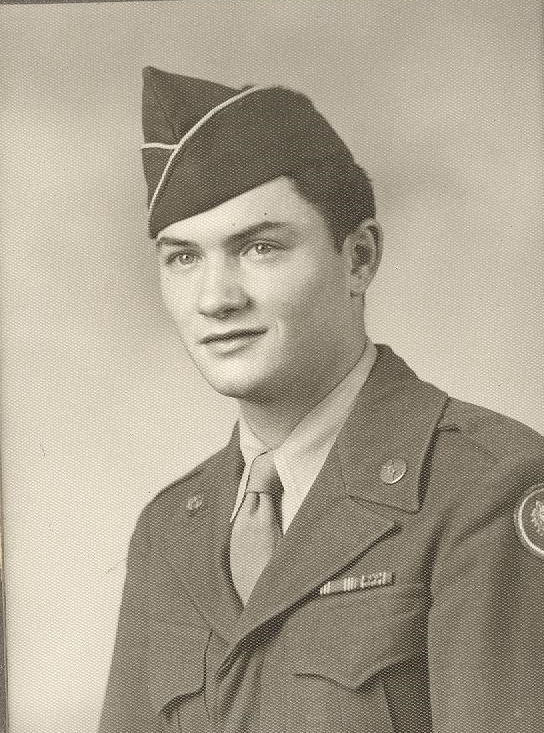
This is not my story. I’m not even a minor character in the story and in fact I wouldn’t be born until six years after the events recounted here. But it is a story that belongs to my family and shaped all of them who then, in turn, shaped me. Parts of it I learned from my mother – it was so a part of her and marked her in a way that I’m sure not even she realized. Parts of it I learned from other family members who lived through it and parts of it from those who came later – the ones who would ask the questions and record the answers.
My mother would say that it began on Dec. 7, 1941. The day that Japan attacked Pearl Harbor.
My brother is 16 years old, a farm boy from Nebraska. “I’m going to join the navy!” he announces with the passion and bravado and I-dare-you-to-stop-me attitude that only a 16 year old boy can pull off. My parents refuse to sign for him. “You will stay in school,” my mother insists (a decision she would second guess before it was all over). If Uncle Sam still needs you after graduation, then so be it.”
After graduation, the letter comes. He is needed, the draft letter explains. And so, just like that, Don Fletcher is drafted into the Greatest Generation – one month after his nineteenth birthday.
By early December, he is in France and headed into the Ardennes Forrest with the 106th Infantry Division assigned to the 423rd Infantry Regiment. Within days they will be engaged in what would later come to be known as the Battle of the Bulge – the largest and bloodiest battle of World War II.
They are told to expect the Germans to throw a few artillery shells, they will fire a few back. No shots have been fired in the past six weeks. This will be a minor skirmish, not a big deal. Early in the morning of December 16th, the artillery shelling begins. It goes all day and all night and on the morning of the 17th, the Germans come for them. It has begun to snow and the skies are overcast, grounding the Allies superior air power. On December 18th, Don is wounded in the arm and trades his M-1 rifle for a 45 semi-automatic because he cannot fire a rifle with one hand. They are going into their third day with no sleep, no food, and the only ammunition they have is what they are taking off the dead. They are surrounded by German troops and cut off from the Allies. At 2:00 p.m. on December 19th word comes down: destroy all personal identification except for their dog tags and prepare to surrender. Two hours later the white flags are raised, and my brother officially becomes a prisoner of war.
The telegram was sent to the Post Master in the small town of Wauneta because there was no phone at my parents’ farm. He brought it to the high school where my brother Irvin and sister Lila were in class and they carried the news home to their parents: Donald E. Fletcher was Missing In Action. And just like that – everything changed. Christmas came and went – unheeded and uncelebrated. My mother’s auburn hair turned gray and tears became her constant companion. My dad got quieter and worked harder; my sister Lila (a year younger than Don) put her plans for nursing school on hold, and life came to a standstill.
When the German soldiers divide their prisoners into the wounded and the non-wounded, Don is taken to a field hospital – a barn with hay on the floor and sheets over the hay. One stall is designated for surgery where they operate on the German casualties during the day and the prisoners at night by lantern light. After his surgery, Don is moved to the “hospital” which is a nearby school the Germans have commandeered. On Christmas Eve some children come through the halls, singing Christmas carols in German, but Don recognizes the tunes and is re-oriented in time. A nurse arrives with a Christmas meal, a big dishpan filled with fried potatoes, and dishes out a meager portion. It is the best meal he will have in captivity.
When he is considered sufficiently recovered to be moved, he is taken to a POW camp across the border into Germany. A German soldier tells him that if he arrives at the camp with his watch and his class ring, they will be taken from him. “Where would you hide them if you were me?” he asks and is advised to slit the lining of his boot and place them there, which he does. They become to him a promise of home.
Conditions at the camp are dismal and the prisoners are starving. They are fed twice a day – at midday they receive a half a potato in some broth and at night a piece of black bread, sometimes with molasses on it. In the beginning, the bread seems inedible to them, but eventually it takes on the feeling of a treat – almost like cake. He and his buddies pass the time by talking about food: they name every kind of candy bar they can think of and then eventually begin to make up names for their own imagined concoctions. They talk about recipes and reminisce about their favorite meals. They think about food. They talk about food. They dream about food. They are literally dying for food.
At home, friends and neighbors tried to prepare my parents for the worst. It is unlikely, they said, that Don is still alive. So many in the neighboring communities had lost sons, brothers, and husbands. “The sooner you accept it, the sooner you can start to heal,” they advised. “You can’t live with this day after day after day.” My mother prayed, she put one foot in front of the other, she sent her children to school, she waited and she cried. And then the dreams began. Don was standing at the foot of her bed and in his hand was piece of black bread, dripping with molasses. He was smiling. After the dreams started, no one could convince her to think of her son as dead. She didn’t argue with them and she didn’t tell them about her dreams, but she clung to them like life itself.
The Allies begin to push in and the Germans move their prisoners to another camp, deeper into Germany. They are still wearing the same clothes they wore the day they were captured and are covered in lice. Conditions will only deteriorate from here. They have even less to eat – but once a day, there is the black bread.
The prisoners assume the Allies are closing in again because they are loaded onto cattle trucks so closely packed they can’t sit or turn around and trucked further in, then unloaded and forced to walk to the next camp – Bad Orb, it is called. Somebody in camp writes a song to the tune of the Battle Hymn of the Republic and they sing it every morning: We’re living on black bread and a beverage they call tea// We’ll keep right on singing till Patton sets us free// Come get us Georgie Patton//Come get us Georgie Patton//so we can all go rambling home. (I can’t, for the life of me, make those words fit into that tune, but it’s not my story so I will tell it the way it came to me.) The guards don’t like it, but they don’t make them stop either and so they sing.
The last week of March the prisoners and their guards begin to hear artillery shelling nearby and then small arms fire and speculate as to its significance. The gunfire grows louder and in the middle of the night on April 1, the Germans abandon the camp. On April 2, 1945, Allied Forces knock down the gates of Stalag 9B at Bad Orb and liberate 6,000 Allied prisoners. My brother is one of the 3,364 Americans freed that day- it is his 106th day in captivity. Behind the tanks comes the Red Cross, bearing gifts of donuts to the emaciated prisoners. Later they hear stories of freed prisoners eating so many donuts that they die. Nobody knows if it’s true. Not even taking time to get their names or their serial numbers, they put them on planes to France and from there my brother boards a ship to America. He is headed home. He weighs 90 pounds; no one will recognize him as the 180 pound, athletic young man who left the farm thirteen months ago.
On May 3 the Postmaster General came to the bank where my sister was working to deliver a telegram. “The Chief of staff directs me to inform you your son Donald E. Fletcher, private first class, is being returned to the United States within the near future and will be given an opportunity to communicate with you upon arrival.” Ulio, the Adjunct General. Lila took the message home to the farm – to deliver this unbelievable and unexpected good news to the heartsick mother and the grieving father. Many years later my sister wrote of that day, “That was a joyous occasion of course and I was so glad to be able to let them know. Seemed like the emotional reaction to that great event was subdued.” Maybe some hurts and griefs are so deep that they never completely heal. Or maybe they just refused to let their hearts believe what their eyes had not yet seen.
As Don makes his way home by plane, by ship, by train and finally by bus, he grows more and more anxious to talk to his family. When the troop train he is riding stops in Kansas City, he gets off and finds a phone. Because the folks don’t have a phone at the farm, he places a call to our Aunt Myrtle who lives in Wauneta. “I’m sorry,” the operator tells him. “That number has been disconnected.” “Then can you just let me talk to the operator in Wauneta?” he begs of her. Finally she connects him. “This is Don Fletcher,” he says to the man he knew in a different lifetime. “Can you get word to my folks?” he wants to know. “Tell them I’m on my way home. I made it and I’m on my home.” It is VE Day. The day that the German troops in Europe finally laid down their arms. “I’ll tell them, Don. I’ll let them know.”
Finally, he is on a bus, headed for Wauneta. His plan is to go to the high school and get his car from our brother Irvin who has been driving it back and forth to school. He goes to the principal’s office. “Irvin’s not in school today,” the principal says. “Well then, I guess I’ll just walk home.” But the secretary tells him that she will drive him herself. News in a small community travels fast. This is in the days of the “party lines” where you can hear your neighbor’s conversation with her sister-in-law’s cousin when you pick up the phone. Someone has heard someone say that someone has told them that someone heard it with his own ears that there is a Prisoner of War from Wauneta who has made it back and he is in town. The folks’ neighbor, Shorty Lambert, hears the rumor and drives to the farm, “I bet it’s Don!” he told them. “Don is home!!!” My dad says they had heard that he is on his way but aren’t sure when he might be arriving. “GET IN THE CAR!! I’ll take you to him!” And that is when the secretary pulled up in the yard. The missing was no longer missing – the lost was found. Later Don would say, “And that was a happy day.” I can’t even imagine.
Don gets ninety days leave and spends them eating and fishing. Someone complains later that summer that they have caught nothing in the local fishing hole. “Well,” comes the answer, “what do you expect? Fletcher was home for the summer and he fished 110 out of 90 days. He pretty much cleaned that place out.” My mother’s cooking and the therapy of that fishing hole gradually begin to calm if not eliminate the nightmares. He would live with them to some degree or another for the rest of his life. The War had exacted a tremendous toll on him and on our family as was true for so many, many others, but the world was safe and free. We would forever owe a debt of gratitude to those who made it so.
By the time I came into the picture in 1950, war was once again on the horizon. In two more years, the country would ask my parents for their second son and the nightmare would begin again. Instead of Europe it would be Korea, instead of Fascism it would be Communism, instead of Don it would be Irvin, but the heartache, the worry, and the burden would be the same.
Epilogue:
Two years ago, I heard, for the first time, this part of the story.
In 1972 Don and his wife bought a motel in Cambridge, Nebraska. They catered primarily to hunters who would come for the season and spend a week or two. A man named Milton came that first year with his son and some friends. They came back year after year and Milton and Don became friends. One evening, after a day of hunting and some drinks, the talk turned to days gone by and to the war and though my brother rarely talked of his experiences during that time, Milton began to share his story. He had been assigned to the 7th Army and was with the troops who liberated a POW camp near Frankfurt, Germany, on April 2, 1945. The name of the Camp was Bad Orb. Two men whose stories intertwine in an eerie combination of fate or providence and now find themselves these many years later, fast and true friends. Sometimes truth is stranger than fiction.
Yesterday I heard this story for the first time:
For many, many years Don never spoke of his time in the War or his experiences there. He married, had a family, tended his huge vegetable garden, caught fish, and worked hard to support his family. When his oldest daughter Jolene was 12 or 13, a movie about the Battle of the Bulge came on the television. “Sit down,” he said. “We will watch this, now.” And then he told them. Most of it.
My mother said that the son who came back from the war was not the one who left – that somehow a part of who he was died there. How could it have been otherwise? And the 40 year old woman who sent her first born off to war was not the same one who welcomed him home from a Prisoner of War Camp. I never knew the first woman – part of her had died, too, somewhere in those 106 days. My mother could never tolerate the song I’m Dreaming of a White Christmas, and any time it would come on the radio or she would hear it in a store, her reaction was strong and almost visceral. I asked her once why she hated it so. “The year Don was missing, they played it over and over and over until I thought I would go crazy. I hated that song. I hated that they played it on the radio. I hated that other people liked it. I still get sick when I hear it.” Enough said.
And now my son is a Marine. My mother had been gone for seventeen years, and I never missed her more than I did during the months in 2006/2007 when Sean was deployed to Iraq. I stopped watching the news, reading the newspaper, or watching any movie that had anything to do with any war at any time. I sent care packages and wrote letters and waited for mail and prayed that no one in a uniform would show up at my door (today’s version of the telegram). Often I would wake in the night, crying for my mother. “How do I do this? How did you do this? How did you survive?” I wanted – I needed – to ask her. But knowing my mother the way I do, I could almost hear her voice, “What choice did I have? What choice, do you have, Sharon? You do what you have to do. You put one foot in front of the other; you put meals on the table; you pray; when you need to, you cry; and if you’re lucky and God knows it’s the only way you will make it through, maybe He will send you a dream.”
This is a war story and a love story. A story of suffering and of hope. A story about family and about friendship. A story about survival and about hanging on. A story about sacrifice. And so perhaps, in the end, this is my story. Maybe it is a story that belongs to us all: to those who pay the price of service and those who are indebted to them.
 because our stories matter